
The primary role of the drilling fluid is to minimize the concentration of cuttings around the bit and throughout the wellbore. If the cuttings cannot be removed from the drilling fluid, the drilling fluid will quickly lose its ability to clean the wellbore and form a thick filter. cake. In order to ensure the circulation and reuse of the drilling fluid at the drilling site, it is necessary to continuously and effectively remove the cuttings from the drilling fluid.
The important role of drilling fluid
-
- Suspended drill cuttings (solids produced during drilling), the drilling fluid carries the drill cuttings at the bottom of the well and in the wellbore to the surface for removal.
- Control formation pressure and maintain wellbore stability.
- Block formation pressure and keep wellbore stable.
- Cool, lubricate and support the drill tool assembly.
- Transmit hydropower to downhole tools and drill bits.
- Reduce reservoir damage.
- Provide sufficient formation evaluation information.
- Anticorrosion.
- It is convenient for cementing and completion operations.
- Reduce environmental impact。
- Inhibit gas hydrate formation

Method for separation solid phase in drilling fluid
-
-
- Screening and separation technology: Shale Shaker
- Cyclone separation technology: Desander cyclone, Desilter cyclone
- Centrifugal separation technology: Decanter Centrifuge
- Gravity sedimentation technology: Sedimentation Tank, Dehydration Device
-
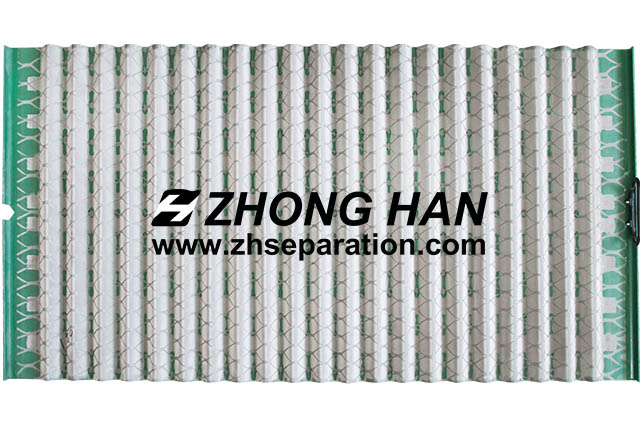
From the method for separation solid phase in drilling fluid, we know the shale shaker is first stage separation for drilling fluid. Shaker screen is the important part for shale shaker, and the largest amount of wearing parts for shale shaker as well. The service life of the screen will affect the pumping of the drilling to a certain extent. The ZH screen is designed to maximize the solids removal capacity of the shale shaker while significantly reducing the costs associated with drilling fluid. The utilization of the screen reduces the drilling solids content in the mud system.
Technological parameter of Hyperpool PWP Replacement Shaker Screen
Material of screen: Stainless Steel 304, SS316, SS316L
Construction Type: PWP(Perforated Wear Plate)/PMD(Pyramid and Pyramid Plus)
Perforated Mesh Shape: Rectangle
Layer of Screen:2-3 layers
Standard: API RP 13C
API RP 13C Designation: API20-API325
Series: DX, DF, HP
Warranty Period:1 year
Hyperpool PWP Replacement Shaker Screen
The Hyperpool shale shaker is newest product designed to meet the demanding demands of today’s oilfield drilling operations. The Hyperpool shale shaker is popular for its compact footprint, industry-leading processing capabilities, solids bypass prevention and low maintenance costs.
How to improve the service life of the Hyperpool PWP Replacement Shaker Screen?
-
- Appropriate screen tension. Insufficient screen tension will cause the screen to vibrate. This is usually a fracture or damage along the edge of the screen or at the hemming bead. In general, in this case, as long as the screen is installed flat, the screen should not be mechanically damaged during use. The vibrating screen can prolong the service life and reduce the excessive damage of the vibrating screen.
- High quality screen. The screen generally has the upper screen layer and the lower force layer, and the two layers are required to be closely fitted. If the pre-tensioning process of the screen is poor, when the force layer at the bottom of the screen is tight, the screen layer will be closed. If there is no tension, the throwing force of the drill cuttings will be greatly reduced during operation, resulting in the screen being unable to discharge the drill cuttings.
- Make sure the vibration motor is turned correctly. The rotation direction of the motor will affect the forward movement of the drill cuttings, which will be much slower, stay on the screen for a long time, and even cause the drill cuttings to fail to discharge.